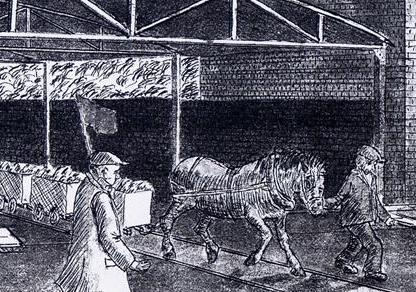
Gellyceidrim Pit Pony Crossing the main road. Drawing
by Glen Jones, 1933.
An important role in the mining industry in the early part of the 20th
century was played by the pit ponies, who spent their working lives
underground. One colliery manager in 1922 gave the following information:
Pit ponies were not allowed to work underground until they were 4 years
old and only the best possible were of any value for colliery work.
It was important to take good care of the ponies, who were capable of
working until quite old. He stated that at the colliery where he worked
(name not given), there were working ponies that had been working underground
for 16 years and were still going strong.
The cost of a pit pony in 1922 was between £50 and £75,
compared to between £25 and £45 before the first world war.
During the war, the manager had paid £180 for one. The cost of
maintaining a pony in 1922 was on average approximately 25 shillings
per week, double what it was before the first world war.
It was essential that the ponies were well fed as their 7 hour working
day was a strenuous one. When a pony went blind, it no longer worked
underground and to protect it's eyesight, in nearly every colliery where
the stables were underground, the animal was brought to the surface
daily. The ponies' eyesight was apt to be greatly affected by exposure
to sunlight after becoming accustomed to the darkness of the colliery.
It was, however, regarded as a difficult and costly procedure to bring
the ponies to the surface daily.
The ponies were credited with having an uncanny way of sensing a danger
which was not apparent to the officials or the men. There were numberous
cases where a pony had stubbornly refused to pass a spot in the colliery
roadway (the name given to a tunnel leading up to a stall), when close
scrutiny then revealed a piece of bad top which at any time could have
caused a roof fall.
Hauliers naturally formed a close attachment to their ponies. Given
this to be the case, the manager who made the statements in this article
said that he was amazed therefore, that during the disorders of the
great coal strike of 1921, there were men capable of the callous and
inhuman attitude of abandoning such wonderful animals to their fate
in the deserted pits.
The 21st of July 1927 edition of the Amman Valley Chronicle, reported
on a compensation claim brought before a judge at Ammanford county Court.
During the proceedings, the claimant; a haulier named Thomas James,
informed the court via his legal representative, of the special relationship
between him and a colliery horse named "Boxer". After receiving
an injury 16 years previously which rendered the man partially disabled,
he was only able to return to work due to the "wonderful understanding"
between himself and the horse. He stated that Boxer possessed all of
the understanding of a man, always doing as it was told and never having
to be led. He admitted that he had driven four other horses, but none
were like Boxer and neither he nor any of the other hauliers were able
to do anything with another horse named "Fire". Sadly, Boxer
had died during the last strike. The barrister representing the defence
attempted to ridicule the claimant by describing Boxer as "A wonderful
horse that died of a broken heart".
Pit ponies also benefited the community in which their colliery was
part of, in another way. At the Gellyceidrim Colliery, the workmen,
who generally grew their own vegetables, were allowed to take the manure
as fertiliser for their garden. A contractor, usually a farmer, was
then allowed to take the remaining manure to fertilise his fields. In
1914, a dispute arose between the contractor and the colliers over the
manure. The workmen, led by a local minister, led a protest march to
the contractors farm to complain that he was not leaving enough manure
for the colliers to use. The contractor attempted to prosecute some
of the party for using threatening language, which the colliers all
denied. The magistrate, however, took the view that a small number of
representatives should have visited the farmer and that it was quite
inappropriate behaviour for that many people to turn up at his farm
to protest.
The information on this page was taken from "Anthracite
and the anthracite industry", by A. Leonard Summers (published
in 1922) and from a 1914 and a 1927 edition of the Amman Valley Chronicle.